Smith County
Resources
Informed Citizens are the Best!
FY27 Bridge Projects
The Smith County Purchasing Department will advertise, solicit, and receive sealed bids for nine Road and Bridge projects included in this year’s work program.
- Projects a, b, c, d, e, and i are funded through the Fiscal Year 2027 Road and Bridge Budget.
- Projects f, g, and h are Road Bond funded.
- A and b are primarily maintenance work—seal coats and fog seal/sealant on residential streets.
- Most of the road improvement projects involve fully reconstructing the road base, widening where possible, often just a couple of feet, cement treatment, and new asphalt pavement. Some projects may include new striping.
- Project g is the bridge replacement on CR 431 at Duck Creek.
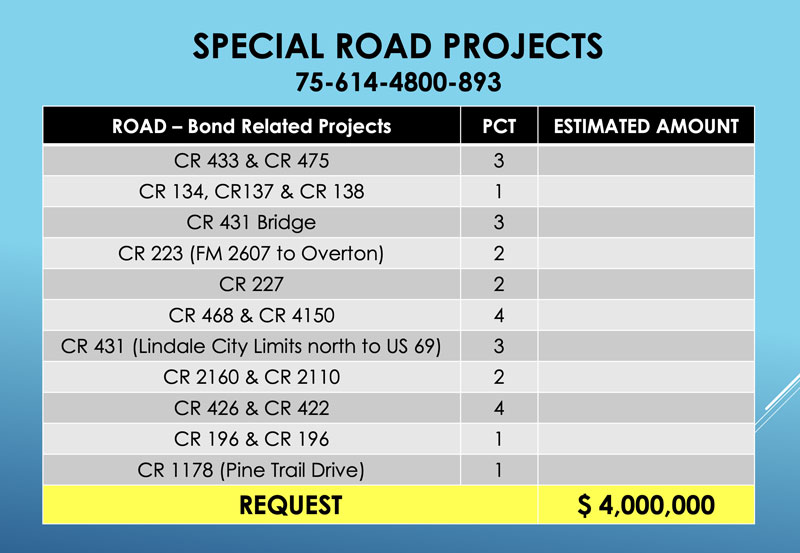
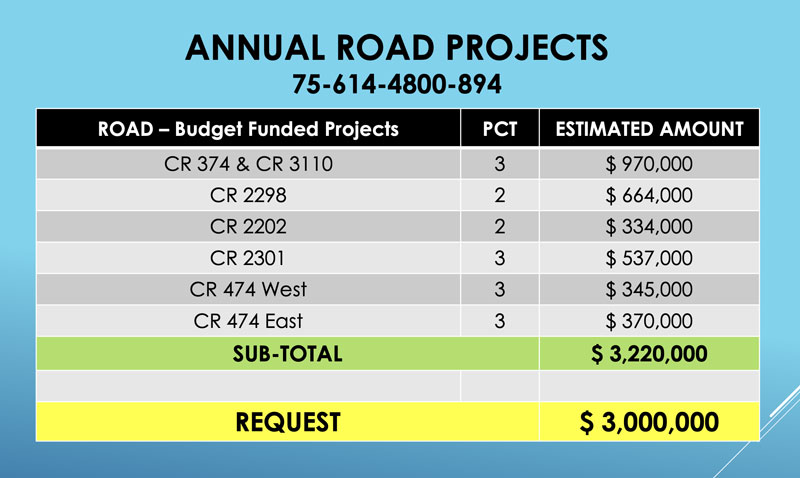
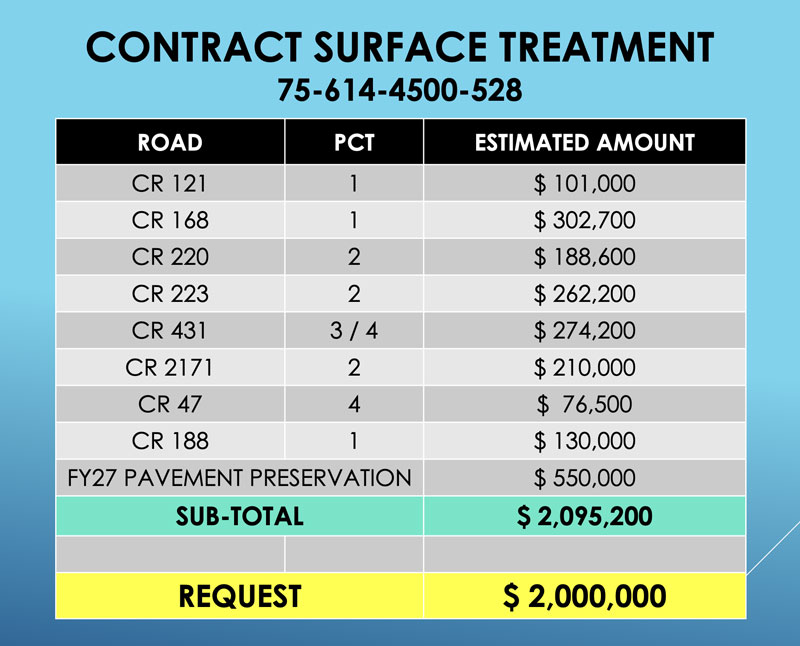
Proposed Road Projects from the FY28 Budget Presentation
Elections Help Needed
If Election Integrity is your cause or you just want a better understanding of how elections work, there are a few ways to get involved. You can work as a paid election clerk or election judge, or you can serve as a poll watcher (which is strictly volunteer and unpaid). Michele’s office trains and pays the clerks and judges, but she does not train poll watchers.
All of the roles start with an online class and test through the Texas Secretary of State’s training portal at pollworkertraining.sos.texas.gov. Once you complete the election clerk or judge training and pass the test, you receive a certificate. Poll watchers also take an online course and receive a certificate, but those certificates are only valid for specific periods (January 1–August 31 or September 1–December 31). Current poll watcher certificates expire December 31, 2026, so they have to retest for the next window. If you’re interested in working a paid position, contact Michele at 903-590-4777.
POLLING LOCATIONS NEEDED:
She’s also looking for another polling location and possibly a replacement for the Noonday Community Center in Flint. A good site needs plenty of parking, handicap accessibility, enough room inside for the flow of check-in, voting, and then casting the ballot, and it has to be available on weekends. We typically use churches, community centers, event centers, or schools. We’ve used private businesses before when they had a side door and room for parking. If you manage or own a place that might work, or you know of one, please let me know.
When Do I Vote and What Am I Voting For?
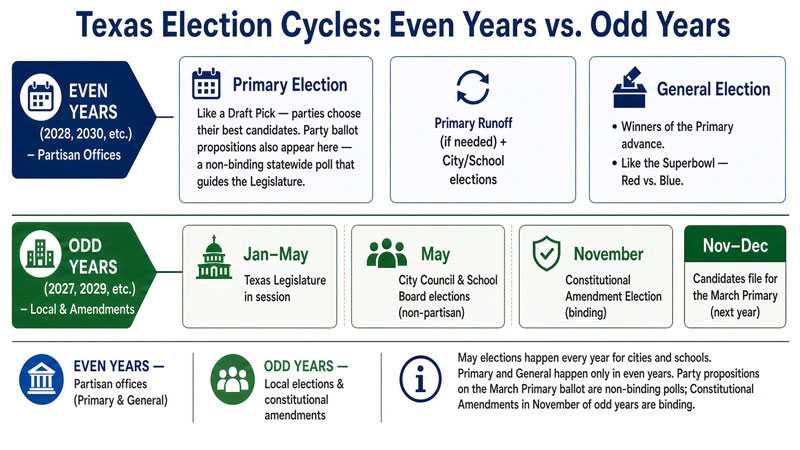
Texas elections follow a clear, repeating rhythm that is easy to follow once you see the pattern.
Even years (2028, 2030, etc.) are when we elect partisan offices. The March Primary is like a draft pick — each party chooses its best candidates. Party ballot propositions also appear on that ballot. They are non-binding statewide polls that give the Legislature a clear sense of what that party’s voters want. Winners of the Primary advance to the November General Election, which is like the Superbowl — Red vs. Blue.
Odd years (2027, 2029, etc.) focus on local and constitutional matters. The Texas Legislature meets from January through May, where they often propose Constitutional Amendments. In November of those odd years, voters decide on those Constitutional Amendments — and if approved, they are binding. In May we hold non-partisan city council and school board elections. From early November to early December of odd years, candidates file for the March Primary of the following year. Once filing closes, those candidates are locked in for the ballot. Most campaigns have already launched before the filing period even opens.
May elections for cities and schools happen every year. Primary and General elections for partisan offices happen only in even years.
This is the basic cycle. Knowing when filing occurs and which offices appear on which ballot helps you stay informed and engaged with the people who represent you.