
Friends,
I wrote this report as if you have been keeping up with this process through my weekly reports, probably been to a Town Hall or joined me at Coffee with the Commissioner. It is a hard thing to start back at the beginning in every report on an ongoing project like the budget. This is a journey, not a drive-by.
This report is lengthy, and it should be. The budget is one of the most complicated and important matters we deal with at the county. I cannot fit this in a report the size of a tv commercial. I care a lot about the budget and I find it fascinating. I write from my passion for this work and from my concern for your tax dollars. You do not have to read every word, but I do appreciate the people who do, because that is what makes the work count. All I can do is put the information out here. You have the freedom to dive in deep, skim the highlights, or just delete it. I still sleep like a baby either way.
I ran on transparency, and sometimes that’s 3,000 words and sometimes it’s 1,000. Either way, I am letting you know what is happening. I hope you get a lot out of this report. As always, I am here to answer your questions. Reach out to me anytime. You should definitely come to our Town Hall on Friday. I will get a lot of great questions, and chances are you had them too. I love it when we can work together like that!
Commissioners Court Notes
Please note: All agenda items are considered PASSED unless indicated otherwise.
OPEN SESSION:
PUBLIC HEARING:
1. Receive input regarding the FY27 Proposed Budget and Proposed Tax Rate; discuss and consider the same.
COURT ORDERS
COMMISSIONERS COURT
2. Consider and take necessary action to adopt the FY27 Proposed Budget.
Comments:
I voted NO on the FY27 budget. The Court adopted it over my no vote – 3 to 1.
I was the one asking us to cut first and to look at the trends. That did not happen. We added 33 positions and millions in new spending instead. Growth is not a blank check. Until this Court does the hard work of reducing cost to the taxpayer first, I won’t put my name on this with confidence.
Auditor Timothy Hollis walked the Court through last-minute corrections that were already baked into the document:
- A salary and fringe line for the District Attorney’s office had been coded to JP 4 by mistake. $54,000 – net zero impact.
- Indigent Health was increased to better match the current run rate – last year it was budgeted at $80,000; the run rate is closer to $110,000.
- Salaries for Constables, the Fire Marshal, and the Emergency Management Coordinator were adjusted from $4,000 down to $2,000 to align with Captains and above in the Sheriff’s Office. The Sheriff used his SB22 Funds and Federal Inmate Housing funds to give those positions a substantial raise but he cannot share the fund with the Constables, Fire Marshal & Emergency Management Coordinator.
That carve-out was not voted on in open court. It was handled in private conversations, and the Auditor was “directed” to put it in the budget. Whether you like the outcome or not, that is not how county government is supposed to work.
People hear “Judge” and think mayor or city manager. That is the wrong picture. A mayor and a city manager are city offices with different authority. This is a county. The County Judge and the four Commissioners are five equal votes on the same Court. On the budget, the Judge has one vote — the same as mine. The Judge cannot pass a budget alone and cannot veto the Court. State law does give the Judge extra power in a declared disaster so one person can act fast in an emergency. A budget call like this belongs in open court, with five votes on the record.
I pointed out a missing item from the budget:
- A fleet seed fund of $500,000 from reserves was agreed on in earlier court meetings but it was still not placed in the proposed budget. After pointing it out, I expect it will be included in the General Operations as we had already discussed.
Something else had not been discussed: insurance on the new courthouse.
Thankfully, Tim Hollis was able to pull up the line item in court. The anticipated cost is $127,800.
That is the problem. The Commissioners Court is left in the dark on the courthouse numbers. We get occasional presentations on how construction is going, and a side remark that we are “on budget.” That is not a budget briefing. There are no specifics, no change-order discussion, and no cost discussion in those presentations.
Judge Franklin attends the courthouse construction meetings with Purchasing Director Jaye Latch and County Engineer Frank Davis. The other Commissioners are not permitted to attend, and we do not receive a written briefing afterward.
The Court cannot do its job on a project this size if four of five votes never see the numbers until the building is finished. We should be getting the costs, the change orders, and things like the insurance amount in open court — not finding the line item because someone thought to ask.
Final Words:
Using reserves to buy down debt and for capital expenditures is the right use of money above the 25% fund-balance policy. What we did not do is a true line-by-line trim. Line items that do not trend that high were left padded because it is easier than going account by account. That is how government grows.
FY28 will be better only if we do the work all year: a travel policy, a vacancy policy, monthly department reports in court, position reviews, performance evaluations, a professional salary study, and full use of the new financial software.
3. Consider and take necessary action to adopt the 2026 Maintenance & Operating Tax Rate.
Comments:
I voted NO on the 2027 Maintenance & Operating tax rate. The Court adopted it 3–1.
Operations grew because we did not cut. The taxpayers shouldn’t carry an extra burden because we didn’t do our best at reducing to trend.
I asked Auditor Timothy Hollis what the M&O rate was last fiscal year and what it is this fiscal year for the record. He answered:
- FY 2026 M&O rate: 0.294308
- FY 2027 M&O rate: 0.317617
That is an increase to the operations rate.
The published taxpayer-impact table in the packet showed the total rate picture:
- 2026 Adopted total rate: 0.364231 per $100
- The FY 2027 tax rate is 0.374088, with tax on the median homestead of about $955 verses $868.32 last year.
The total rate can look softer because we used the rainy day fund to pay some of this year’s debt.
The M&O rate is the operations piece, and it went up.
4. Consider and take necessary action to adopt the 2026 Debt Service Rate.
Comments:
I voted YES on the debt-service rate.
The voters signed the “note “ on the debt at the ballot box, and we pay what we owe.
A cheaper debt rate this year is not a cheaper tax bill for good. Five million dollars of reserves could just be a one-time help. I look forward to paying off the 2018 and 2019 bonds. Mr. Hollis confirmed the 2018 bond rolls off in 2028 and the 2019 series in 2029.
5. Consider and take necessary action to ratify the property tax increase from raising more revenue from property taxes than in the previous year.
I voted NO on the tax increase. The motion passed 3–1, with Commissioners Caraway and Herod and Judge Franklin in the majority.
Population plus inflation is the taxpayer test — did government grow faster than the people and the cost of living? That is the Conservative Texas Budget / SB 1336 approach.
- Population grew by 1.4%.
- Prices in this region are up about 2.9%.
- Together that is a 4.3% for the Population + Inflation measurement.
- This budget raises $6,139,669, or 5.77%.
We should use the same measuring stick the state uses on its own spending — population plus inflation — as a fair way for the public to judge whether this county grew faster than the people we serve.
- People grew a little over one percent.
- Prices grew about three.
- Taxes grew almost six.
We are increasing funding 28% higher than what the state uses as a measurement.
- Line 10 of the Truth in Taxation worksheet shows $79 million of value newly exempt properties this year, which is about $288,000 of levy at last year’s rate. So, we lost $288,000 in revenue from ALL the new property exemptions this year.
- New property on the tax roll is $3.06 million.
This is the statement I read into the record:
STATEMENT FOR THE RECORD
Commissioner Christina Drewry, Precinct 1
I am not a politician. I am an EMPLOYEE of Precinct 1. I see my BOSSES every month — whether it’s my weekly Coffee with the Commissioner, my monthly Town Halls, checking on road issues or their replies to my weekly emails. They know what’s happening with their money because I tell them. And they told me, plainly: Don’t raise my taxes. Trim your own budget first.
On the evening of August 25, more than 40 citizens came to that Public Hearing. I knew about a dozen of them by name. The rest I may not have met before that night, but I heard them. The message wasn’t complicated. It wasn’t partisan. It was the customer talking to the people who work for them: No. Do a better job with what you already have.
So — I vote my precinct today.
This budget raises the tax rate when families are already paying more for everything. The county will quote about $86 dollars more on the “typical” homestead. That is how you make a tax increase sound small.
- It will be felt in every escrowed mortgage payment.
- It will limit our first-time homebuyers.
- It will force people to consider moving to another county for lower taxes.
- It will drive people out of homes they have built memories in for decades.
Renters are not spared. They will pay this increase on a house they do not own. The landlord doesn’t eat that bill. You don’t serve the customer by mailing them a higher bill and calling it leadership. A smaller increase is still an increase. It takes choices off the table.
It doesn’t have to be this way. Tarrant County is larger than we are. Under Judge Tim O’Hare they have adopted a rate below the No-New-Revenue rate 3 years in a row. They trimmed first. If they can live within the growth, Smith County can too. The difference is backbone.
Good customer service means we spend their money the way they would spend it. We didn’t do our very best. We miss opportunities to put high-cost items out to bid. We are reactive not proactive, and that cost is on the taxpayer. Line items that do not trend that high were left padded because it is easier than going account by account.
That is not having a backbone and that is how government grows.
On pay we put a band-aid on salaries instead of a real plan. It doesn’t fix the wide differences in pay that HR identified. We should use reserve dollars — one time — for a professional salary study so FY28 can fix it on a measured plan, not another patch.
I will give this Court credit where it served the customer. Using reserves for capital and to buy down debt is the right use of money above the 25 percent policy. We staffed the new courthouse — a good start.
We are setting up a fleet fund line item, but we still need centralized fleet management.
FY28 will be better only if we do the work all year — a travel policy and vacancy policy, monthly department reports in court, position reviews, performance evaluations, a professional salary study, a new Budget Officer, and the new financial software.
Here is the hard truth, and Smith County is a prime example of it. Government does not have an appetite to cut spending. In the next legislative cycle, lawmakers will consider lowering the ceiling from 3.5% to 1%. And rightfully so.
The voters will get to decide if we are truly “Striving for Excellence.” If the Texas Legislature succeeds with this priority, an increase like this one will have to be justified to the people who pay it. That is the upside.
- We will have to prove we trimmed the fat.
- We will have to prove the request is a need, not a want.
- We will have to prove that we are performing well.
If we earn the trust of the customers, they will decide to approve an increase above 1%. The FY 2028 work we discussed is a first step.
Precinct 1 did not hire me to conform to the status quo. Citizens are tired of being taken advantage of and ignored. We didn’t prove this large of an increase was necessary, that we did everything we could to reduce waste, and they are not pleased with this tax increase.
Smith County, we have to do better for our customers. That is why I vote no.
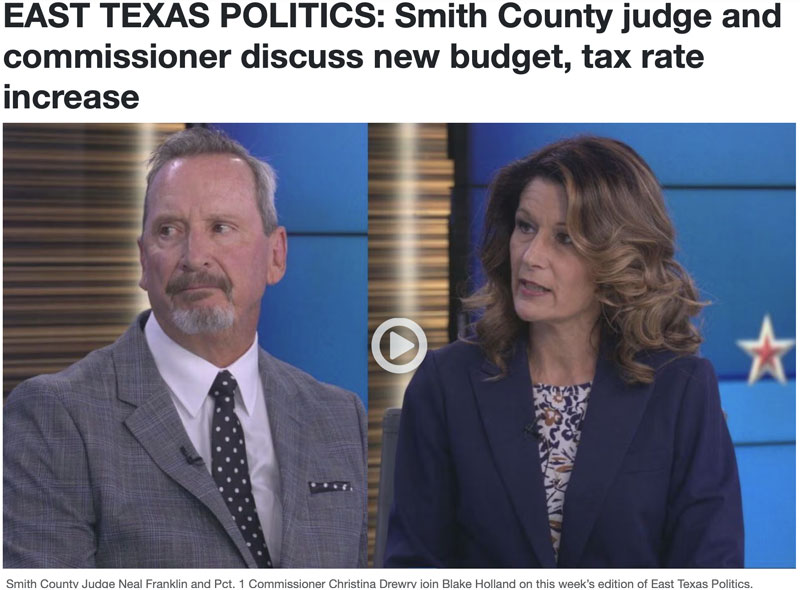
This week Blake Holland interviewed both Judge Franklin and I for his show East Texas Politics. I am honored that Mr. Holland would share his audience with me and he asked some great questions about our budget.
If you would prefer to watch it on Facebook, here is that link…
6. Consider and take necessary action to adopt the FY27 Salary Scales.
Comments:
I voted YES on the FY27 salary scales after I verified they were correct with HR and had the Auditor’s sign-off. Last year we had to come back with a $66,000 correction after adoption. I asked that we not repeat that. Notices that went out to elected officials on August 13 did not have to be reissued after the change, per Civil District Attorney Thomas Wilson.
What we still do not have is a real plan to fix the wide pay differences HR has already identified. A one-time professional salary study paid from reserves would let FY28 fix it on a measured plan instead of another patch.
RESOLUTION
7. Consider and take necessary action to approve a resolution proclaiming September 17-23, 2026, as “Constitution Week” in Smith County.
Comments:
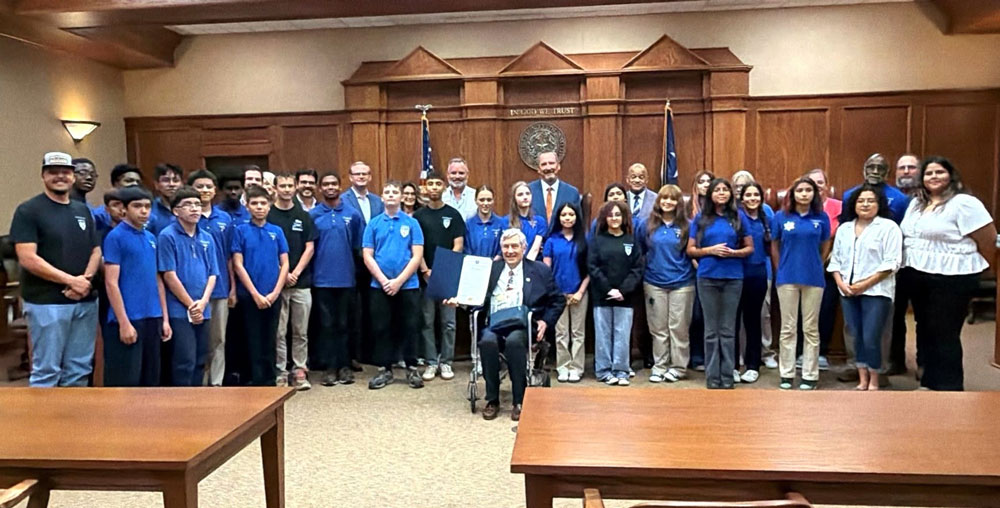
This resolution was on the agenda because a constituent asked for it. Bob Brewer is a regular at Commissioners Court and a longtime advocate for the Constitution. He reached out and asked that Smith County formally recognize Constitution Week. I was proud to put his request on the agenda and to help get this proclamation into the courtroom.
Constitution Week matters. The Constitution is the supreme law of the land and the charter that secures our liberty. September 17, 2026, marks the 239th anniversary of its signing. Federal law calls on schools that receive federal funds to hold an educational program on the Constitution, and Texas public schools observe Celebrate Freedom Week during the week in which September 17 falls.
I want to recognize our own State Senator Bryan Hughes of Senate District 1. While serving East Texas in the Texas House, Senator Hughes authored House Bill 1776, which strengthened Celebrate Freedom Week and required Texas students to study the Declaration of Independence, the United States Constitution, and the Bill of Rights. It is fitting that Smith County honor that work.
I am grateful to everyone who came to court to mark this week with us:
- State Representative Daniel Alders, House District 6
- State Representative Cole Hefner, House District 5
- Reece DeWoody, District Director for Senator Bryan Hughes, Senate District 1
- Elizabeth Cockerham, District Director for Representative Cole Hefner, and staff from Representative Hefner’s office
- Joel Enge, Founder and Director of Kingdom Life Academy, along with six staff members and a room full of Kingdom Life students
Thank you to Representative Alders, Representative Hefner, Mr. DeWoody, Mrs. Cockerham, Mr. Enge, the students, and Mr. Brewer. Liberty is not automatic. It has to be taught, talked about, and defended. I appreciate every one of you for showing up and setting that example in Smith County.
PRESENTATION
8. Receive burn ban update from Fire Marshal Chad Hogue.
Comments:
Fire Marshal Chad Hogue briefed the Court on current drought conditions and the county burn ban. I appreciate him coming to the podium so the public can hear the facts directly and be reminded that we are still under a burn ban. Please make sure to let your neighbors know. It’s hard to believe in this modern time that some people are uninformed on the burn ban but Fire Marshal Hogue sees it every week.
COURT ORDERS
PURCHASING
9. Consider and take necessary action to award contracts for the following bids and authorize the county judge to sign all related documentation:
- RB-05-26 Road Improvements to CR 334 (US 271 to FM 2015),
- RB-07-26 Road Improvements to CR 1139 (Spur 364 to Dead End),
- RB-08-26 Road Improvements to CR 1130, CR 1227 & CR 1141, and
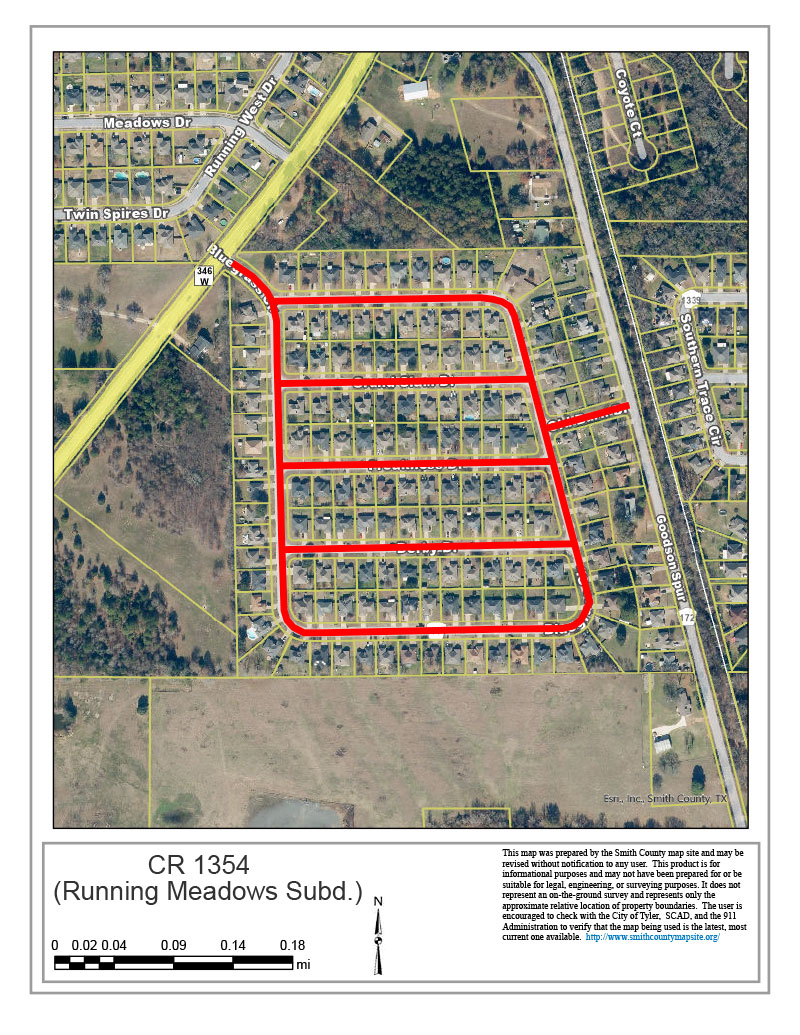
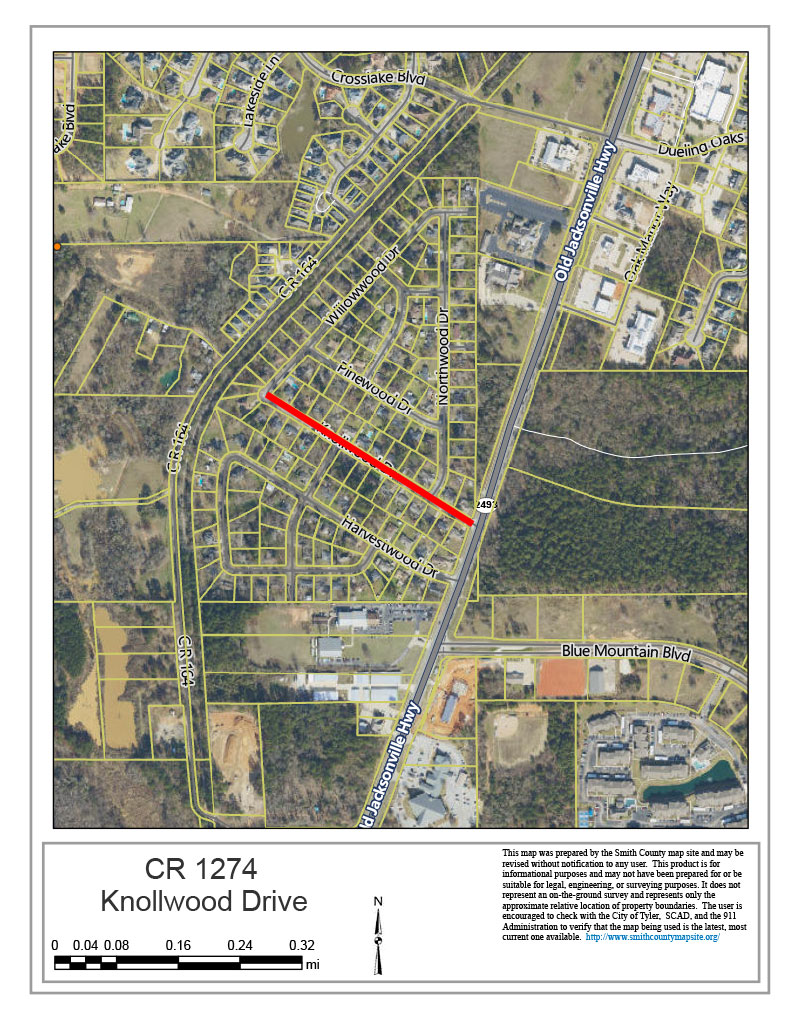
- RB-09-26 Road Improvements to CR 1354 & CR 1274 (Knollwood Drive).
Comments:
All four projects were advertised and opened in the competitive market. We awarded low bid on each item.
These are all Bond Project Roads.
- RB-05-26 — CR 334 (US 271 to FM 2015): 4.356 miles, 120 calendar days to complete. Awarded to A.E. Shull & Company at $1,575,496.90.
- RB-07-26 — CR 1139 (Spur 364 to Dead End): 2.178 miles, 90 calendar days to complete. Awarded to A.E. Shull & Company at $745,377.75.
- RB-08-26 — CR 1130, CR 1227 & CR 1141: remix and cement-treat existing pavement and base, with a modest widening of the road. This is 4.451 miles of improvement. Awarded to L.S. Equipment Company, Inc. at $1,490,899.60.
- RB-09-26 — CR 1354 & CR 1274 (Knollwood Drive): 1.667 miles. 90 calendar days to complete. Awarded to Lonestar Equipment Company, Inc. at $590,315.25. These are residential roads.
I asked about warranties, inspections, and whether other in-house work would delay these jobs. Engineer Frank Davis confirmed the 1 year warranties, that the Road & Bridge Department does inspections during the process and after completion, and that the drainage work is already done. All are items that the taxpayers need to know to be assured that their tax dollars invested in the roads are protected.
SHERIFF’S OFFICE
10. Consider and take necessary action to approve a grant from the Texas Department of Transportation in the amount of $108,811.00 for Selective Traffic Enforcement Program (STEP).
Comments:
We approved the TxDOT STEP Comprehensive grant of $108,811.00 for October 1, 2026 through September 30, 2027.
This is overtime traffic enforcement in marked units in high-crash parts of the county. Deputies will work STEP shifts on top of regular patrol. The focus is DWI, speed, occupant protection, intersection control, and distracted driving — especially around holidays.
How it works, from the answers given in court:
- Captain Halbrooks keeps the hours and files the reports to TxDOT and the Auditor. That paperwork is how the grant stays in compliance with Article 2, Item M: “…all information collected, assembled, or maintained by the applicant relative to this project shall be available to the public during normal business hours in compliance with Chapter 552 of the Texas Government Code, unless otherwise expressly provided by law.”
- The Court asked for public updates so citizens can see whether the extra patrol is working.
- The application funds 2,032 law-enforcement hours — 1,626 deputy, 203 sergeant, 203 lieutenant — plus 100 admin hours.
- A typical STEP shift is extra time a deputy signs up for. It is not a substitute for regular patrol. It is in addition to it.
- Four zones were chosen because they have a high number of injury and fatality crashes. They are areas, not one-off addresses. The community has asked for more marked units in those stretches.
- Extra miles on the cars and extra fuel are a real cost.
This is a good use of a grant. It puts more marked units on roads where people have asked for more patrol, without using a substantial amount of tax dollars. The county match is around $23,000.
11. Consider and take necessary action to approve the 2027 Sheriff’s and Constable Fees for Smith County, pursuant to Texas Local Government Code, Section 118.131, and authorize the county judge to sign all related documentation.
Comments:
We approved the 2027 Sheriff’s and Constable fee schedule. Chief Jones and Civil DA Thomas Wilson confirmed the proposal had been circulated. I asked whether all Constables were in agreement: not every Constable was spoken with personally, but the item was sent out for review. These fees are how the offices recover the cost of serving papers and providing statutory services. The public deserves to know that schedule is reviewed in open court, not just renewed on autopilot.
RECURRING BUSINESS
AUDITOR’S OFFICE
12. Consider and take necessary action to approve and/or ratify payment of accounts, bills, payroll, transfer of funds, amendments, and health claims.
EXECUTIVE SESSION
13. Receive update and briefing regarding the status of all pending litigation and claims involving Smith County.
ADJOURN