Commissioners Court Notes
Please note: All agenda items are considered PASSED unless indicated otherwise.
Commissioner John Moore was absent. I was also unable to attend due to a back injury and was seeking medical treatment. The remaining members of the Court — Judge Franklin, Commissioner Herod, and Commissioner Caraway — handled the agenda.
OPEN SESSION:
RESOLUTION
1. Consider and take necessary action to adopt a resolution proclaiming November 10, 2026, as “East Texas State Fair Rodeo Day” in Smith County.
COURT ORDERS
COMMISSIONERS COURT
2. Consider and take necessary action to adopt a resolution of support for the Old Hopewell/Swan Freedom Colony’s application for an “Under-told Stories Historical Maker” from the Texas Historical Commission.
Comments:
The Court adopted a resolution of support for the Old Hopewell/Swan Freedom Colony’s application for an “Undertold Stories Historical Marker” from the Texas Historical Commission. This marks the 160-year anniversary of that community.
Texas Historical Commission procedures require local government involvement as part of the marker application process. For most official Texas Historical Markers, the County Historical Commission reviews the application first. For the Undertold Markers program, which focuses on underrepresented or previously untold stories and is funded by the state, applications can go directly to the THC, but a formal resolution of support from the Commissioners Court is one of the standard steps that strengthens the application and shows local endorsement. That is why this item appears on the Court agenda. No representatives from the community were present, so the full resolution was not read aloud, but the Court voted to support the application.
3. Consider and take necessary action to approve the FY27 public service interlocal agreements between Smith County and the following organizations, and authorize the county judge to sign all related documentation:
- Alzheimer’s Alliance of Smith County,
- CASA for Kids of East Texas,
- The Children’s Advocacy Center (CAC) of Smith County,
- Civil Air Patrol,
- Meals on Wheels Ministry, Inc.,
- People Attempting to Help (PATH),
- Smith County Historical Society,
- St. Paul’s Children’s Foundation,
- Tyler Economic Development Council (TEDC), and
- Tyler Family Circle of Care.
Comments:
Judge Franklin, Commissioner Herod, and Commissioner Caraway approved the FY27 Public Service Interlocal Agreements. These are the annual contracts with local nonprofits:
- Alzheimer’s Alliance of Smith County: $11,808
- CASA for Kids of East Texas: $50,000
- The Children’s Advocacy Center (CAC) of Smith County: $50,000
- Civil Air Patrol: $6,000
- Meals on Wheels Ministry, Inc.: $15,000
- People Attempting to Help (PATH): $6,000
- Smith County Historical Society: $3,750
- St. Paul’s Children’s Foundation: $5,000
- Tyler Economic Development Council (TEDC): $100,000
- Tyler Family Circle of Care: $50,000
During budget workshops, the direction from several of us was that this should be the last year the Court funds these public service agencies, and that the money should come from reserves (commonly known as “Rainy Day Fund”) rather than from additional taxation of property owners. The Court has contractual obligations to certain organizations for the current year, and those must be honored. Going forward, the careful planning discussed was for the Court itself to decide whether any continuation is appropriate — not for an outside group to recommend who receives taxpayer dollars.
Judge Franklin had also placed a separate agenda item on this same November 10 meeting to create a Smith County Public Service Agency Budget Committee. The background listed on that item said:
“This committee will be made up of 9 members (8 citizens and the Budget Officer), to discuss and recommend budget policies for the expense of county funds provided to local non-profits, through the County’s Public Service Interlocal Agreements. Once a recommendation is made the committee, through the Budget Officer will present its recommendations to the Commissioners Court for approval.”
The eight citizens named were Brent Byers, Barbara Bass, David Stein, Cary Nix, Brad Curtis, Garnett Brookshire, Tom Trimble, and Shannon Dacus.
This was the Agenda Item Request Form:
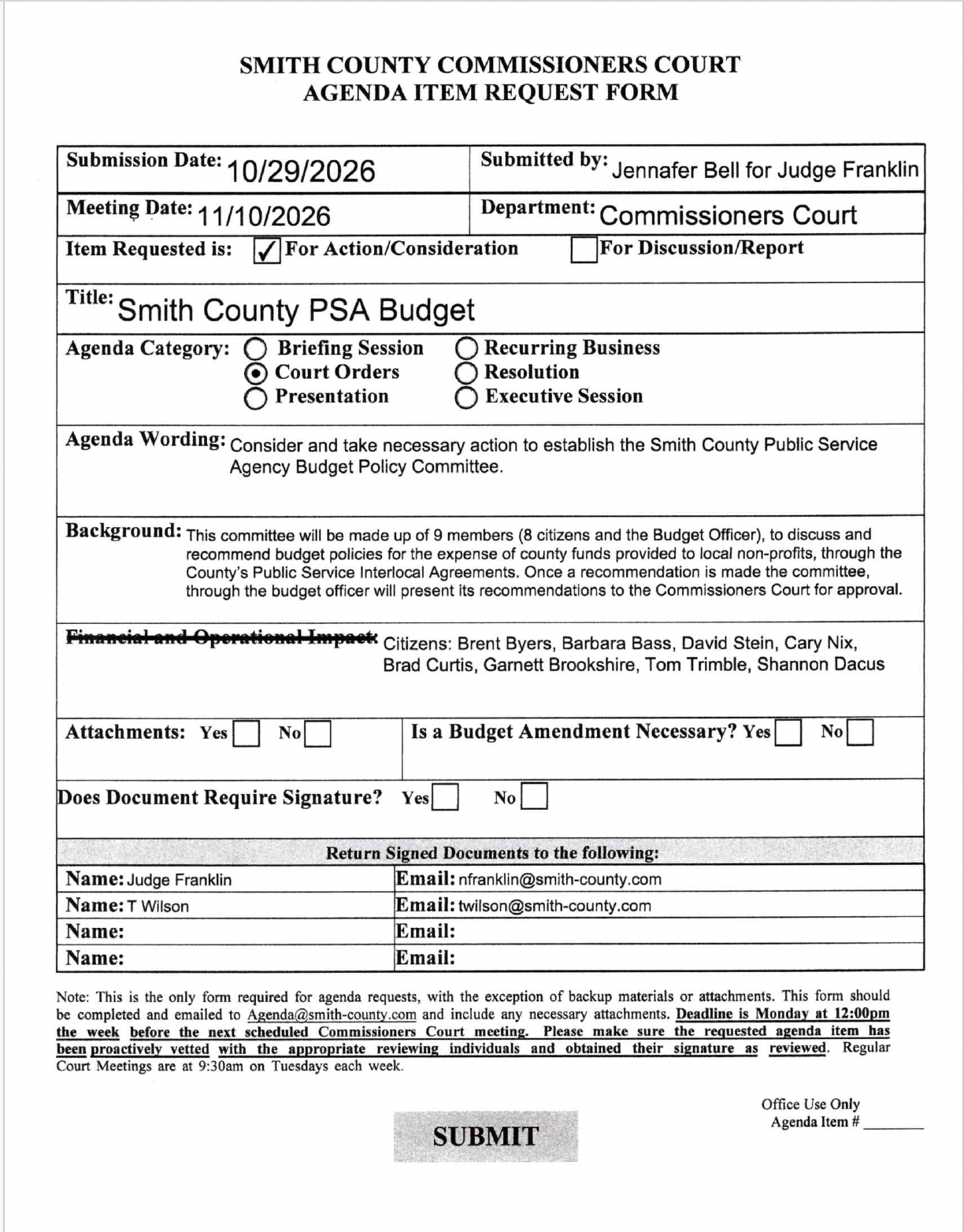
Judge Franklin pulled the item before the final draft for the following week’s agenda came out, after I sent an email outlining my concerns. I appreciate him considering my reasoning for removal.
Regarding Judge Franklin’s Selected Committee Members:
These individuals have given a great deal of their time to important boards that help the community, and several have put their own money behind causes they believe in. Brent Byers and the Byers Family Foundation, for example, have made major private gifts, including a $2 million commitment to help establish an Alzheimer’s and dementia center at UT Tyler. Barbara Bass has been recognized for her long record of civic leadership and volunteer service including PATH, Tyler Economic Development Council and she is a partner at Gollob Morgan Peddy, the firm that performs our third-party audit. David Stein has served for years in leadership roles with United Way of Smith County, including as campaign chair. Shannon Dacus, Garnett Brookshire, Brad Curtis, and the others have similarly invested their time in local nonprofits, the Chamber, the Economic Development Council, and related foundations. That private philanthropy is exactly the right way to support these organizations.The problem is that those same affiliations create a conflict for a committee that would recommend how taxpayer dollars are spent on the same groups.
Here’s Why This Committee is a Problem for Taxpayers:
- The Court has no legal authority to hand taxpayer money decisions to a private citizen committee. Budget decisions belong to the Commissioners Court in open session.
- Your tax dollars should not be given to private nonprofits in the first place. That is a community responsibility — people who want to support these groups can write their own checks. That is what freedom looks like.
- This committee would hear the presentations and pick the winners and losers out of public view. Taxpayers would not see the presentations or have a chance to speak before recommendations were made. Closed-door decisions about public money are exactly what people have complained about for years.
- During budget workshops, several of us said this should be the last year of funding, paid from reserves, not from new taxes. Judge Franklin initiated that conversation this year.
- The people named already have close ties to the organizations that get or want the money. That is a conflict of interest when public funds are involved.
- The item was placed on the agenda with members already named. There was no prior public discussion by the full Court on whether a committee should even exist, no public notice inviting citizens to apply, no stated rules on who would be eligible (including conflicts of interest or ties to funded organizations), and no requirement that the committee’s meetings be advertised so the public could attend.
Handing this off to a private committee is worse than the Court doing it in the open. I am fighting to keep your tax dollars from being used as a donation. Citizens who support these organizations should do so with their own money. Decisions about taxpayer dollars should stay with the Commissioners Court in open session, not be handed to a private committee.
You don’t “donate” your property taxes. The bill comes whether you feel generous that year or not.
If you want to speak up about this, here is a generic email statement that you can start with and amend to your own personal style:
Dear Judge Franklin,
I am a Smith County taxpayer writing about the public service agency funding on the November 10 agenda.
I do not support using county tax dollars to fund private nonprofits. Supporting those organizations is a community responsibility. People who want to help can write their own checks.
I also do not support creating a committee of private citizens to hear presentations and recommend which groups receive donated taxpayer money. All funding decisions should be made by the Commissioners Court in open session, where the public can see.
Email Judge Neal Franklin: nfranklin@smith-county.com
Tips for emailing elected officials:
- Shorter messaging is better on a known topic.
- Be respectful. A clear, polite message is more likely to get a response.
- Include your name and preferred contact information. Anonymous emails are easy to ignore.
- Multiply your voice by talking with friends and encouraging them to email.
Finally, I would encourage you to consider giving your own money to the organizations you believe in. Even a small gift of $5 matters when neighbors pitch in together. If a third of our population gave just $5, these groups would feel the difference, and they would be grateful for every person who stepped up. Our Founding Fathers understood that charity and looking after one another are the work of the community, not the work of government. The Constitution was written to keep government limited; it was never meant for government to take over social services and healthcare. When we give from our own checkbooks, we keep that responsibility where it belongs — with us.
4. Consider and take necessary action to approve a Cooperative Agreement between Smith County and Texas A&M AgriLife Extension Services and authorize the County Judge to sign all necessary documentation.
Comments:
The Court approved the Cooperative Agreement with Texas A&M AgriLife Extension Services. This continues the long-standing partnership for educational programs in agriculture, family and consumer sciences, 4-H and youth development, and community development.
The agreement runs through August 31, 2031, and renews annually. The county provides office space, support, and budgeted funding for operations; AgriLife provides the agents, specialists, and programming. No direct payment is made to AgriLife under this agreement — funding stays with county processes.
5. Consider and take necessary action to approve an order authorizing the FY27 Smith County Collection of a Mandatory Payment under the Local Provider Participation Fund pursuant to Texas Health and Safety Code, Chapter 291A, and authorize the county judge to sign all related documentation.
Comments:
I hear you when you say medical costs are too high. I feel that too. There is a bigger problem here — too much government in healthcare has driven costs up and made insurance harder to afford for a lot of families. Texas did not expand Medicaid, and I support that decision. More government involvement in healthcare has already driven costs up. Expanding Medicaid would have grown that problem, not solved it. At the same time, Texas has the highest uninsured rate in the country — about 16.5% overall, nearly double the national average — and here in Smith County roughly one in five working-age residents is uninsured. That means a lot of people still show up at the hospital without coverage. Our local nonprofit hospitals still treat those patients. They cannot turn people away at the emergency room. That care costs money, and when patients cannot pay, the hospitals absorb the loss. Over time that pressure makes it harder for them to keep serving the community.
The Legislature created a tool called the Local Provider Participation Fund (LPPF) to help with this. It is not a tax on you. It is a mandatory assessment the hospitals themselves pay to the county. The county collects that money and sends it to the state as an Intergovernmental Transfer. That allows Texas to draw down matching federal dollars that come back to help cover uncompensated care and other Medicaid-related costs at those same hospitals. In short, the hospitals put money in so the state can bring federal money home. No general taxpayer dollars are used for this.
Starting October 1, 2026, the state changed the rules. The hospitals now have to calculate and pay the assessment separately for inpatient care and outpatient care, based on their most recent Medicare Cost Reports. Those two pots of money have to go into a dedicated new bank account so the state can track them cleanly. That is why the county needs a new bank account setup right now. It is bookkeeping so the money moves correctly and we stay eligible.
Mary Catherine Jackson from Christus Health came to court to explain this to the public. I have a lot of respect for her and for the work she and the hospitals do to keep this funding flowing for Smith County. The Court approved the order authorizing the FY27 collection under Chapter 291A so the county can keep participating and get the new account set up correctly. This helps our local hospitals continue serving uninsured patients without shifting the cost onto property taxpayers.
6. Consider and take necessary action to approve the Automobile Claim Settlement, Claim Number APD20266310-1 from Texas Associations of Counties and authorize the county judge to sign all related documentation.
Comments:
This item is on the agenda because the vehicle was totaled and the county needs to finish removing it from inventory. A Sheriff’s Office Deputy was involved in a motor vehicle accident that resulted in a total loss of a 2024 Chevrolet Tahoe. The deputy was determined to be at fault. The vehicle was fully covered under the current TAC insurance policy.
Settlement details:
- Actual Cash Value: $43,555.00
- Less Deductible: $2,500.00
- Less prior payments: $17,353.39
- Net payment to county: $23,701.61
The Court approved the settlement so the county can receive the insurance proceeds and remove the totaled vehicle from inventory.
7. Consider and take necessary action to approve the Automobile Claim Settlement, Claim Number APD20266655-1 from Texas Associations of Counties and authorize the county judge to sign all related documentation.
Comments:
This item is on the agenda because the vehicle was totaled and the county needs to finish removing it from inventory. A 2021 Chevrolet Tahoe in the Sheriff’s Office was totaled in an accident. The Deputy was determined to be at fault, and the vehicle was fully covered.
- Actual Cash Value: $24,293.59
- Less Deductible: $2,500.00
- Less Initial Payment: $13,696.19
- Net payment: $8,097.40
The Court approved the settlement to finalize the insurance recovery and clear the vehicle from county assets.
AUDITOR’S OFFICE
8. Consider and take necessary action to approve a resolution from the Texas Department of Agriculture, Texans Feeding Texans: Home Delivered Meal Grant Program for FY27 Meals on Wheels Ministry grant funding and authorize the county judge to sign all related documentation.
Comments:
The Court approved the resolution that allows Meals on Wheels Ministry to apply for the FY27 Texans Feeding Texans Home Delivered Meal Grant. This resolution helps bring in additional state funds at no extra cost to local taxpayers.
9. Consider and take necessary action to approve a resolution designating the county judge as the Authorized Office to apply for, decline, modify, or cancel the grant application for the Indigent Defense Formula Grant Program and all other necessary documents to accept said grant; and designate the County Auditor as the Financial Officer for the grant.
Comments:
The Court approved the annual resolution that keeps Smith County eligible for the Texas Indigent Defense Commission (TIDC) Formula Grant. This is the standard designation of the County Judge as the authorized official and the County Auditor as the Financial Officer.
Here’s the Taxpayer “Big Picture”:
The FY27 adopted budget sets aside $3,619,370 for Indigent Defense (Department: 446). Almost all of that comes from the General Fund — property taxes, sales tax, and other general revenues. The bulk of that spending is attorney fees for contract and appointed counsel. The county primarily uses contract attorneys for each district court — currently four contracts per court at $120,000 per year each — with the wheel system used for some additional cases. The contract rate increased from $95,000 to $120,000 under a prior administration, and the number of contract attorneys has grown. The overall Indigent Defense line has increased from about $2.7 million actual in FY24 to the $3.62 million adopted for FY27, driven mainly by those higher contract payments and more attorneys.
What comes back from the state through the TIDC Formula Grant is much smaller.
Recent reimbursements:
- FY21: $148,115
- FY22: $108,344
- FY23: $139,377
- FY24: $143,349
- FY25: $128,822
That’s typically only a few percent of what the county spends. Taxpayers cover the rest.
The public has a right to know there are other models. Many Texas counties have moved to a Public Defender Office, a Managed Assigned Counsel Program, or a hybrid of both. TIDC provides free planning studies so a county can see what would work best for its caseload and budget. They also offer Improvement Grants with multi-year step-down funding to help stand the office up, often starting with TIDC covering most of the cost in the early years. Research and experience in other counties show these systems can move cases faster, reduce jail days, and sometimes lower overall costs while still meeting constitutional requirements.
Questions worth asking:
- Are we getting the best value for the $3.6 million budgeted for this?
- Could a dedicated office or hybrid setup clear the docket faster and reduce jail costs?
- What model would work best for Smith County if the numbers were looked at through a TIDC planning study?
Approving this resolution keeps the county in the Formula Grant program. The bigger conversation is whether the current structure is the most efficient use of taxpayer dollars going forward.
RECURRING BUSINESS
COMMISSIONERS COURT
10. Receive monthly reports from Smith County departments.
Comments:
No one came to present their report. I am so grateful Fire Marshal Hogue joined in by submitting a report in the packet for this standing monthly agenda item! I will continue to encourage department heads to share their monthly metrics with the public during court. It’s important for taxpayers to see the work being done with their dollars — work orders completed, calls answered, cases processed, and more. Transparency helps everyone stay accountable. You can look through their reports included in the linked public agenda packet at the top of this report. I highly recommend reviewing what your employees are accomplishing in their departments for you day in and day out!
ROAD AND BRIDGE
11. Consider and take necessary action to authorize the county judge to sign the:
- Final Plat for the FM 344 South Subdivision, Unit 3, Precinct 1,
- Re-Plat for Veritatis Splendor, Lots 2 and 3, Precinct 3, and
- Re-Plat for Thousand Oaks, Lot 1, Precinct 3.
12. Receive pipe and/or utility line installation request (notice only):
- County Road 1174, Brightspeed, install fiber optic cable, Precinct 1,
- County Road 317, Entrust Solutions, install fiber optic cable using directional bore, Precinct 3,
- County Road 452, Entrust Solutions, install fiber optic cable, Precinct 3,
- County Road 4129, DFW Telecom, install fiber optic cable, Precinct 3,
- County Road 46, Oncor Electric, perform aerial work on existing pole, Precinct 3,
- County Road 1269, 1248, 1179 and 1145, Metronet, install fiber optic cable with directional bore, Precinct 4, and
- County Road 3186, DFW Telecom, install fiber optic, Precinct 3.
AUDITOR’S OFFICE
13. Consider and take necessary action to approve and/or ratify payment of accounts, bills, payroll, transfer of funds, amendments, and health claims.
ADJOURN